Challenges
• Traffic needed to be maintained on city streets, excavation depths up to 20-ft., construction site limitations to 30-ft. wide
• Multiple existing utilities significantly reduced room for conventional excavation, utility relocation was not feasible
• Geology was known to contain glacial till soils with cobbles/boulders
• Encountered existing retaining wall tiebacks along 6th Street, potential to be directly in line with the proposed tunneling zone
Solution
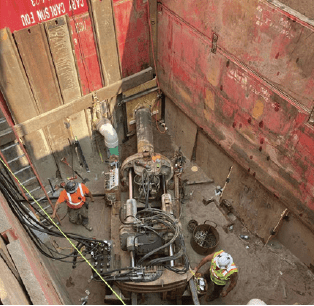
The original project design posed trenchless installation at intersection crossings totaling 338-lf. Because of all the project challenges, the contractor proposed pilot tube microtunneling for the the entire project, totaling 977-lf.
Some of the launch and reception shafts were horizontally shifted to circumvent existing utilities directly in conflict with the shafts.
The soil borings indicated a section along Hennepin Avenue, transitioning from poorly graded sand (terrace deposit) to a lean clay (glacial till). The contractor knew from experience that this transition could contain cobbles/boulders and performed test excavations which confirmed their theory. Working with the city and engineer,they reduced the length of the sewer section in favor of increasing the grade to stay above the transition layer.
Minger crews pushed pilot tubes approximately 100-lf., got past the Hennepin Avenue and 6th Street intersection before encountering an obstruction. They quickly switched gears to excavate the receiving shaft at the obstruction area. The remaining 80-ft. was installed by open-cut methods. The open-cut section was reduced to about 12-ft. deep by increasing the grade.
Minger requested drawings for the existing retaining wall tiebacks, installed in the early 2000s. They were able to determine that if they shifted the alignment a couple of feet and raised the grade about 6-in., they could circumvent them. With the grade and alignment changes, tunneling through this section was successful. After tunneling, while excavating an intermediate shaft for utility connections and a manhole, they noticed that they cleared the tiebacks by less than an inch!
The remaining footage was installed without incident.
Outcome
All pipe was installed exactly on line and grade, completed below budget, and a month ahead of schedule. The project greatly reduced impact to the public since pilot tube microtunneling is much less intrusive than open cut. The decision to tunnel all the footage reduced restoration costs by 65% over the original design.