Project Overview
Part of a large natural gas pipeline project, a crucial 295-ft., 48-in. crossing under Ormond Creek, BC was designed for guided pipe ramming as the most suitable method, and one that adhered to the project’s stringent environmental standards. Unexpectedly, bedrock was revealed on both sides of the creek when the subcontractor embarked on pit construction. Evident that the project scope had changed, an alternative methodology needed to be pursued.
Challenges
• Installation in bedrock
• Stringent environmental standards
• Project owner was not in favor of a project design change
• Alternative methods were more invasive, possibly cost prohibitive and had the potential to disrupt the water body and its ecology
Solution
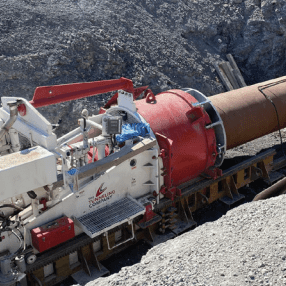
The RBU was selected as the prevailing choice for its ability to core through solid rock conditions without introducing the potential for a release of foreign contaminates into the water body.
The paired auger boring system could deliver the necessary torque to advance the RBU in rock conditions without fatiguing or damaging the drive train when rotation was disengaged.
The RBU 48 features:
• (18) 6.5-in. disc cutters, capable of five tons ea.
• Cutter head rock scrapers to assist in transferring cuttings away from the face, to the inlet cavity, then to the lead auger
• (4) stabilizer shoes to maintain a concentric cutter path and make minor steering corrections
• Fluid connection port for main bearing and cutter head cooling and assitance with the transfer of cuttings to the augers
• Capable of up to 25,000 psi UCS rock conditions
Outcome
• Most productive shift installed 40 ft. of pipe in eight-hours
• The final carrier pipe was slip bored through the cored rock without coating damage, ensuring the long-term reliability and integrity of the gas line
• Construction on the crossing using the original design was completed safely, efficiently, and effectively without environmental impacts in two and a half weeks