Project Overview
The City of Memphis needed to replace the deteriorating triple-barrel siphons under the Wolf River, to help prevent any disruptions. The siphons were past their life cycle being that they were constructed in 1958 and connected to an 84-in concrete interceptor tunnel.
Challenges
• Critical line and grade tolerances
• Heavy traffic
• Logistical challenges
• Minimal pipe clearances
• Potential high water levels: Seasonal flooding
• Time critical
Solution
For pre-qualifications, the city officials required an experienced tunneling contractor that had installed projects of at least 10,000-If of 42-in. diameter or larger jacking pipe. J&J Boring Inc. met those requirements and had previously worked with both Magnolia Underground and the City of Memphis.
Microtunneling was used to see how close in proximity the site is to the Wolf River. Over time the project morphed into a design-build type environment, with alignment changes, as well adjustments to pit locations due to the ground conditions.
Going to and from the job site was challenging for the equipment and pipe materials. In order to move onto the job site an access road with a steep grade was built off the shoulder of Highway 40 to access the underside of the North McClain Road overpass.
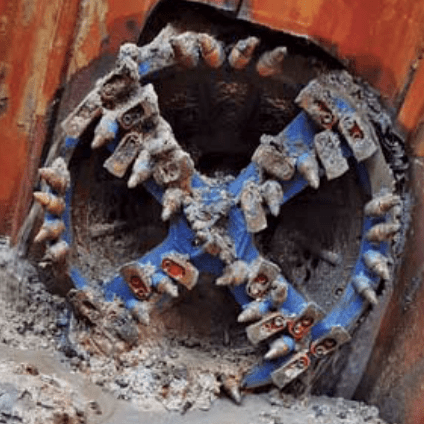
J&J Boring, Inc. consulted Akkerman to review the project specifications and together they selected a new SL44C microtunneling system and pit seals in the shafts for each alignment.
Outcome
Each 380-lf barrel siphon was launched from a single, 20-ft deep shaft with minimal horizontal clearance between each installation. Once the first drive was completed, the crew mobilized the SL44C MTBM back to the launch shaft to set up for the second run. On this run, the crew was able to exceed the first drive’s production rate by installing 220-If in a single shift. On the final run, the crew logged another 200-If before its completion in just 22 hours.
Magnolia Underground constructed the entry and exit pits and J&J Boring installed a pit seal for each run on the launch side and cut holes in the sheet piling at the exit pit.
Bouquet says what aided in the pace of the runs was that the crew did not use a slurry separation plant, instead using a settlement pond with water pumped out of the Wolf River, which, while saving time, was also cost-effective.
The project was completed without any issues from the seasonal rise of the Mississippi River and Wolf River, instead of using a which did occur after the equipment removal.